
Women and girls across the UK continue to miss out on the freedom and wellbeing that active travel can bring, because too many routes still feel unsafe. This International Women’s Day, Carole Patrick, our Director for the National Cycle Network, shares examples and practical steps we can take to help create safer, more inclusive walking, wheeling and cycling networks.

Making routes safe and accessible for women benefits everyone. PHOTO: Chris Foster Photography
When cycling feels unsafe, women miss out
"I walk more than I cycle. I’m the Director of the National Cycle Network, so that might seem like a strange statement. However, it speaks to the reality for many women and girls. I’m not especially confident on a bike. On-road cycling isn’t appealing - I feel unsafe amongst busy traffic", says Carole Patrick, Director of the National Cycle Network.
"I love the off-road routes though. They take motorised traffic out of the picture, and they offer access to the natural world. But these routes are mostly unlit, and sometimes quite isolated, and I don’t feel comfortable after dark."
"The end result is that I’m missing out. I don’t get all of the benefits – mental and physical – that come from being able to get around my community on two wheels."
Barriers keeping women and girls from walking, wheeling and cycling
Over the years, our research has shown a stubborn cycling gender gap – and it isn’t changing. As we gear up to publish the latest addition of the UK's Walking and Cycling Index on 17th of March, the data is telling us the same old story.
The number of women cycling is still persistently half that of men.
That’s not played out in other countries. Women in the Netherlands cycle slightly more than Dutch men, and almost three times more than their UK counterparts. One of our charity’s priorities is to better understand the barriers to active travel for women and girls in the UK and Ireland, and take practical steps to remove or reduce them.
"We know from our research that safety is one of the main reasons that women are less likely to walk, wheel or cycle than men. That’s particularly true of cycling", says Carol Patrick. "Where I work in Edinburgh, 45% of women said they feel safe cycling compared to 56% of men, according to the city’s new Walking and Cycling Index report."
And safety concerns become even greater for women at night.

Warmley Wheelers © 2018, Jonathan Bewley
What can we do to improve it?
We’re looking at ways we can help traffic-free walking, wheeling and cycling routes feel safer.
We are also calling on local authorities across the UK to help develop a network of walking, wheeling and cycling routes that are separated from traffic, and linked to the National Cycle Network.
Here are some examples from our work that made women and girls feel safer when walking, wheeling and cycling.

The Walking and Cycling Index
The Walking and Cycling Index supports leaders of cities and towns to understand and improve walking, wheeling and cycling across the UK and Ireland.
Lighting the way
The Spen Valley Greenway is a leafy railway path which runs between Dewsbury and Bradford. In the daytime it’s a busy thoroughfare for people commuting to work, school and the shops. And it’s well-loved by dog walkers, runners and cycling groups.
But in the winter months, when the clocks change, the numbers drop off at peak times as the route is not lit. A survey found that only a tenth of women (half as many as men) felt safe on the path after dark.
Thanks to funding from West Yorkshire Combined Authority, we’ve improved the surface of the route, opened up access, and installed new lighting between Cleckheaton and Liversedge. One local woman, Selina, walks on the greenway each day. She’s pleased with the improvements and is looking forward to the lights being switched on.
“They really help the path feel safer,” she says. “It was quite narrow before and sometimes you’d have to stop for a cyclist to pass. I like to walk in the evening and I’d happily do it in winter as well if the path was lit up and feels safe.”
In Edinburgh, we’ve worked with Scottish Canals to install new lights on a section of the popular canal towpath at Fountainbridge, on Route 75. Sam Shaw from Scottish Canals explains why this was a priority for the path’s redesign:
“We’re conscious that in Edinburgh there are dark spots that do suffer from anti-social behaviour. The canal has traditionally been one of those areas. Lighting was a really important part of the project. We’ve gone for nice tall columns so we get good facial recognition."
"This means that it will be safer for all users at each part of the day."
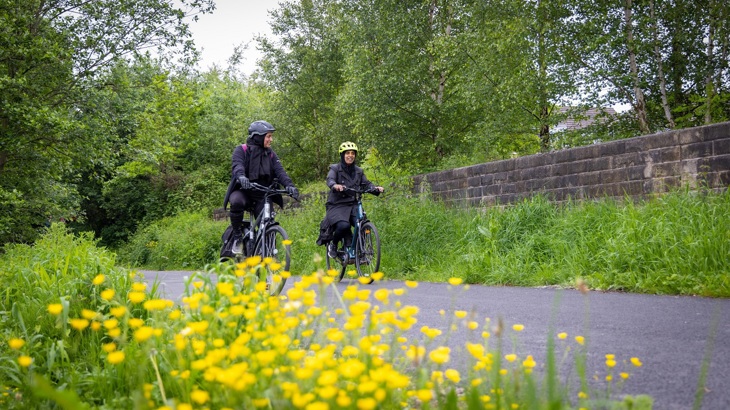
Improvements have been welcomed by local women on the Spen Valley Greenway. PHOTO: Chris Foster
Design changes
While lighting undoubtedly helps places feel safer, it won’t necessarily stop or even reduce crime. Installing lightening may also not be possible in many green spaces. However, sometimes lower budget options that change the way the route looks and feels can be just as effective.
In Newtown, Powys, we held workshops and site visits with local women to find out what they thought would help their section of Route 81 feel safer.
They highlighted issues such as not being able to see what’s around the corner of the path due to its alignment, isolation, darkness and lack of lighting, as well as infrequent or hidden exit points.
In response to this feedback, our team worked with the local authority to reroute the path from a dark narrow lane at the back of a house, to instead go around the front part of the house, which was less secluded and benefitted from street lighting.

Spen Valley Greenway
The Spen Valley Greenway is a green corridor with wonderful moorland views that will take you out into the beautiful Yorkshire countryside.

This section of Route 81 in Newtown, Powys was isolated, dark and narrow before the changes
Buddying up
Building communities who support each other to walk, wheel and cycle can also help improve feelings of safety and overcome cultural barriers for women to get active. This creates a powerful ripple effect as people inspire each other to choose healthier and happier forms of transport.
Fozia Naseem leads inclusive rides for female groups in Bradford, and regularly uses the Spen Valley Greenway. She says being in a group has helped more South Asian women in the community feel confident to try cycling.
“No one in the group would cycle on their own but because we’re with them they feel more supported and can build confidence. There’s a fun element too as you can make friends and motivate each other.”
Hattie lives in Glasgow and uses cycling as her main mode of transport. She also sees the value in community but has struggled with cycling groups being male dominated.
“I wanted to join a cycling club so I tried going along to some group rides with different clubs. More often than not, I would be the only woman there. On the whole people [men] are nice enough, but I'd always get at least one comment along the lines of 'you're pretty quick for a girl' or 'well done for keeping up'", she says.
“More women-only or WTNB (women, transgender and non-binary) groups for different types of cycling and at different levels would be great, but it would also be nice to have more mixed cycling groups.”
Gathering women’s views from the path
At Irvine Harbour, our research team trialled a Women’s Safety Audit, for the first time, to pull together data from women about what areas felt safe and what could be improved. We wanted to hear directly from women about what would help them to feel safer in places they want to walk, wheel and cycle.
Local women completed the audit questions and took pictures on their phones as they walked around the route. The comments were then mapped according to the specific location and will be used to help redesign the area.
We’re using the results of this trial to further develop the Women’s Safety Audit Tool for our work on active travel routes and neighbourhoods across the UK.
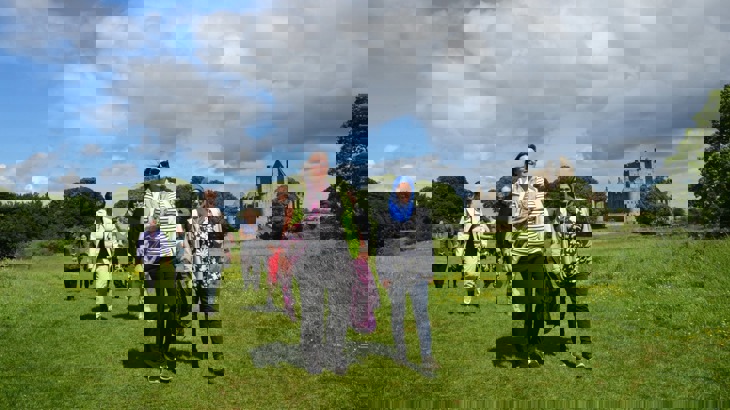
Women on a walk near Craigmillar Castle ©2019, Julie Howden
Developing a blueprint
As part of our new strategy we’ll be kickstarting new collaborative design projects across the UK to improve the National Cycle Network for women and girls.
By understanding the detail of people’s experiences on the ground, we can help to redesign places to feel safer, and empower more women and girls to walk, wheel and cycle, whatever the time of year.
Using learning from these projects, we hope to create a blueprint for gender-inclusive co-design that can support planners across the UK. Because when women feel safer, everyone benefits.
We work with partners and professionals across the UK, helping them to make walking, wheeling and cycling an easy and safe option for more communities up and down the country. Find out more on how we can work in partnership to make it possible for everyone to walk, wheel and cycle safely.

Our strategy
Read more about how we’re making long journeys possible for everyone by making it easy to walk, wheel or cycle to catch a bus, tram or train in our new strategy.


