Every city is on its own path, shaped by its context, politics, and people. Infrastructure Delivery Manager, Perla Mansour, travelled from Belfast to Brno in Czech Republic to better understand how cities can tackle transport poverty. In this blog she shares what she found and how this can be applied to our work in Northern Ireland.

The Svratka river revitalisation new greenway is one of many traffic-free active travel infrastructures in Brno. Credit: Perla Mansour.
As an Infrastructure Delivery Manager at Walk Wheel Cycle Trust, I had the great opportunity to travel from Belfast to Brno- Czech Republic, through the Belfast Healthy Cities Explorer Bursary.
My aim was to better understand how cities can tackle transport poverty through more inclusive, participatory, and sustainable transport planning.
Transport poverty is not just about affordability or access; it is about who gets left out of transport systems entirely.
And often, those missing journeys are the most important ones to plan for.
The problem: Planning for the past, not the future
In our practice of planning transport infrastructure, we rely heavily on existing data like recorded journeys, traffic counts, and established patterns.
These datasets typically reflect people who already have access to transport options: those who are mobile, those confident cycling, those able to afford public transport, or having access to a car.
But what about the journeys that are not being made?
How can we affect model shifts towards the use of more sustainable transport options if we are only planning for past patterns?
In many cases, barriers like cost and accessibility mask deeper, hidden challenges, like the fear of unsafe roads, the lack of trust in reliable public transport, or disconnected active travel networks.
These barriers disproportionately affect communities already excluded from sustainable travel options.
If planning continues to rely only on past data, it risks reinforcing inequality rather than enabling change.
To achieve a real modal shift, we need to better understand present and future needs and recognise the journeys of those currently absent from the data.
While Brno’s timeline aligns well with Belfast on delivering active travel infrastructure, my decision to visit Brno was particularly influenced by how it prioritises community engagement for active travel planning, from its innovative model of participatory budgeting to the direct involvement of communities in network planning.

Understanding people's daily patterns and how we can connect people to their diverse daily needs, must be reflected in transport planning. Credit: Brian Morrison.
Learning from Brno: Participation as infrastructure
Brno offers a compelling model for addressing data gaps.
Similar in scale and ambition to Belfast, the city has set clear targets for 2050, aiming to reduce car use and prioritise public transport, walking, and cycling.
But what stands out is how this is being planned.
Emotional mapping: Making invisible barriers visible
One of the innovative engagement tools employed by Brno is “emotional mapping.”
Residents are invited to input their experiences directly onto the city map; highlighting where they feel safe, unsafe, comfortable, or excluded.
This approach transforms subjective perceptions into actionable data.
Safety, often considered intangible, becomes measurable through heat maps and qualitative insights.
Importantly, it captures voices that traditional surveys often miss.
In Brno, emotional mapping of the Big Brno Cycling Survey has directly informed the city’s Sustainable Urban Mobility Plan (SUMP) and on-going cycling strategy.
It revealed a critical insight: the main barrier to cycling was not topography or weather, but perceived safety and lack of connected infrastructure.
In the emotional map ‘Non-Cyclists’ were asked to express their perception of safety, and label precisely on the map those places they identify to be risky or dangerous from a walking and cycling perspective.
This reframes the challenge entirely. It puts the focus on improving people’s experiences starting from the place itself instead of a high-level mobility plan.

The city of Brno uses online emotional mapping to gather feedback from residents. Credit: Perla Mansour.
Integration matters: Connecting active and public transport
Another key lesson from Brno is in their integration of active travel with public transport.
Brno’s strength is that over 50% of journeys in the city are already being made via public transport due its highly efficient, well-connected tram network.
Hence, rather than treating cycling and walking plans as separate systems, Brno is aligning the active travel plans with their transit corridors, prioritising linkages to and from tram stops and train station.
Initiatives like tramline greening and improved segregation as traffic calming measures, along with subsidised bike-sharing journeys (Free first hour use for up to two journeys/day!) are enabling affordable, seamless, multimodal journeys.
This approach recognises that sustainable transport systems must work as a whole.
Active travel is not just a standalone mode; it is often the first or last mile of a journey.
Belfast is starting to recognise active travel as a key enabler of increased public transport use.
However, public transport must also deliver more reliable services and stronger connectivity.
Providing subsidised bike-share schemes, with stations located at key rail hubs and bus stops, could drive greater access to both cycling and public transport.
Participatory budgeting: From ideas to delivery
Brno also leads in its pioneering participatory budgeting practice ‘Dáme na vás’ (It’s Up To You) giving residents direct influence over how public funds are spent on local projects including active travel.
Since its introduction, the city has received hundreds of project proposals annually, with citizens championing and voting on which ones they want to see delivered, and project budgets varying between £20K-£200K.
This process does more than fund projects, it builds trust. Dáme na vás’s website displays a step-by-step project timeline and openly communicates projects’ stages, challenges and outputs.
Residents are not just consulted; they are decision-makers.
From small-scale street improvements to green infrastructure and active travel routes, participatory budgeting creates visible, community-driven change.
If they took part planning it, they will use it!
It also highlights a universal truth: whether in Brno or Belfast, people consistently prioritise safer streets, better green and open spaces, and more accessible ways to move and experience their neighbourhoods and cities.

Belfast Walking and Cycling Index
Walking, wheeling and cycling in Belfast saves the NHS £11 million locally each year due to the health benefits of travelling actively, according to the largest assessment of active travel in the UK and Ireland.
This is the sixth time we've collaborated with the Department for Infrastructure of Northern Ireland to survey active travel in the city in the latest Belfast Walking and Cycling Index.
Reflections: What works and what needs improvement
Brno’s approach offers valuable insights, but it is not without challenges.
What works well is that the city is building a strong foundation in data and engagement.
Emotional mapping, co-design workshops, and participatory budgeting create a transparent and inclusive planning process.
This helps build public buy-in from early stages, particularly for contentious issues like walking, wheeling and cycling infrastructure.
However, challenges remain.
Participatory budgeting, while powerful, can be too broad without clear alignment to local strategic goals and direct integration to delivery timelines.
Cross-departmental collaboration could be strengthened, and political buy-in continues to be a hurdle; something many cities will recognise.
From Brno to Belfast: Applying the lessons
The parallels between Brno and Belfast make these lessons particularly relevant.
First, participatory processes need to be embedded early.
Difficult conversations about street space, priorities, and trade-offs should happen before planning begins and lines get drawn on maps. Transparency is essential to building trust.
Second, emotional mapping offers a powerful opportunity to align transport planning with public health.
Understanding how and when people access healthcare, employment, and social spaces can reveal critical gaps in the network, especially for those most at risk of transport poverty.
Our daily life patterns, peak-hours and rush-hours have all shifted, especially since the Covid-pandemic; and how we connect people to their diverse daily needs moving forward must reflect that.
Third, there is an opportunity for participatory budgeting to be more strategically structured in Belfast.
By aligning it with existing frameworks like the Belfast Agenda or the Eastern Transport Plan, the city could empower both people and local authorities/ governmental departments alike.
“Shovel-ready” local projects that are pre-selected and voted on could be one way of addressing budgets underspending on active travel infrastructure for example.
Finally, the biggest shift is conceptual and operational: Transport planning must move beyond existing journeys and focus on reflecting movement patterns that are not being made or enabled.
These are the journeys that reveal inequality and the greatest opportunity for change, and that information can only be obtained through place-based embedded engagement.

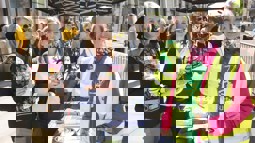
When residents become decision-makers in transport planning, we can create visible, community-driven change. Credit: Walk Wheel Cycle Trust.
A shared journey
Every city is on its own path, shaped by its context, politics, and people.
But the goal is shared: creating transport systems that are accessible, inclusive, and sustainable.
My journey to Brno demonstrates once more that tackling transport poverty is not just about infrastructure, it is about process.
It requires listening differently, planning collaboratively, and designing systems that reflect the needs of all citizens, not just those already moving.
If we are serious about shifting how people travel, we must first shift how we plan.