
The government’s just released their third Cycling and Walking Investment Strategy, and it’s got big ambitions. In the first of a series of blogs, Dan Simpson, our policy and public affairs manager, breaks down what the funding means.

Councils can now plan ahead to invest in better walking, wheeling and cycling networks CREDIT: Jonathan Bewley
Cast your mind back to 2015. Uptown Funk was everywhere. You may not have heard of Donald Trump, and TikTok didn’t even exist.
Consistent funding for walking, wheeling and cycling was also just a dream. Where roads funding was getting legally-binding funding for a five-year period, cycling and walking didn’t.
With others, we wanted to change that. Rachel White, now our Head of Policy and Communications (and my boss), was key to convincing the government they should put a Cycling and Walking Investment Strategy into law.
Over a decade later, we can see the benefits of that. There are safer streets all over the country thanks to the funding the strategies have provided.
Now, the government’s confirmed their third Cycling and Walking Investment Strategy to cover 2025-30. It’s ambitious. But how much money is there?

Walking, wheeling and cycling saved the NHS almost £2 billion Credit: Chris Foster/Walk Wheel Cycle Trust
Hundreds and thousands
The strategy sets out £4.5 billion of funding. But large numbers can often seem a little meaningless.
To put it into perspective, the equivalent strategy for the strategic road network is £27 billion because, frankly, roads are very expensive.
In the previous strategy, there was £4.1 billion set out, so it’s a similar amount of money once inflation is taken into account.
If we find the targets aren’t being met, though, the government will need to find a way to increase this funding further.
Because even when finances are tight, we know investment in walking, wheeling and cycling pays off.
Our Walking and Cycling Index found that walking, wheeling and cycling save the NHS almost £2 billion already, and that will only get higher with more investment.
Spending on active travel compared to roads
£4.5 billion
Third Cycling and Walking Investment Strategy 2025-2030
£27 billion
Road Investment Strategy (2026-2031)
Is the strategy worth the paper it’s written on?
The money is also largely not new – it’s already been announced.
You might think we’d be disappointed, then. No new money? But, in a tough financial climate, we’re reassured to have certainty over funding – there’ve been cuts elsewhere.
Now that the strategy has been put into law, it’s unlikely the government will try to cut active travel funding, particularly after campaigners successfully legally challenged previous cuts.
And where the previous funding was distributed every year, it’s now being confirmed for several years in advance.
That means councils can plan ahead and make money go further, knowing they can embark on ambitious, impactful schemes without having to stop half way through.
Ringfences and devolution
The other thing which nuances this figure is that only £1 billion of that flows directly through Active Travel England.
That’s because this government’s committed to devolution.
Where there used to be lots of separate pots, they believe councils and regions can use money more effectively with bigger pots.
For example, funding which can be used for any mode of transport will make it easier to build things like transport interchanges without worrying about which mode the funding comes from.
Eventually, mayors will have “integrated” settlements, as already exist in Greater Manchester and the West Midlands. That means they can, within reason, spend money how they see fit.
Again, this is about making money go further. An area may realise that spending more on transport will reduce the need for social housing funding, for example, because people can access more jobs.
Because of all this, much of the funding is a projection of how much of these pots will be spent on walking, wheeling and cycling. That’s made some people worried the funding won’t be used for active travel.
We’ll keep an eye on this, but, again, we’re not too worried.
Firstly, there are targets which local councils can be held to around road safety, and these will require investment in walking, wheeling and cycling.
Secondly, almost all councils want to invest in walking, wheeling and cycling – they know the benefits this brings to their communities.
Finally, the government has looked back at their previous projections for how this funding was used, and they held up well.
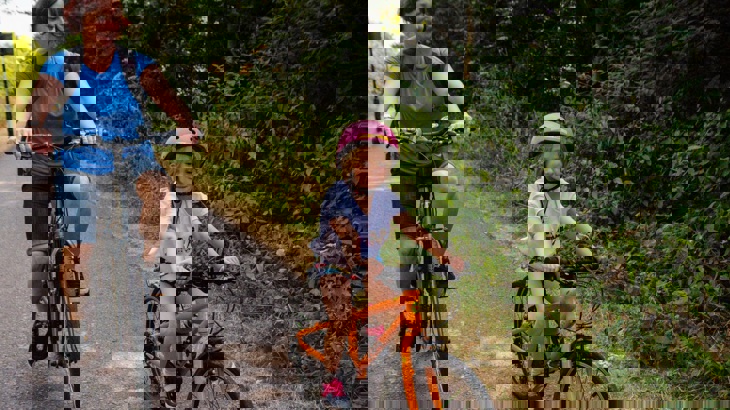
The new funding can help create safer places for families to travel on foot, cycle or with mobility aids.
What next?
We’ve got almost to the end of this blog without mentioning the National Cycle Network. You may know we look after the Network – signed paths and routes for walking, cycling and exploring outdoors.
The emphasis on long-term certainty of funding in this Strategy bodes well for the Network.
Previously, we’ve had to plan year by year, leaving the risk that we can’t continue with our plans to make the Network work for everybody – or even keep it well maintained.
Since its publication, a Transport Minister answered a question saying that the same arguments for long-term certainty apply to third sector partners like us.
We’re hopeful this means long-term funding for the Network will be confirmed soon, giving us this same certainty.
In the meantime, let’s start working with councils and mayors to use the money we’ve got.
Billions of pounds in a table are meaningless, but new crossings, wider pavements and safer streets aren’t. They ripple out and change our lives for the better.


