
Air quality in the UK has dramatically improved over the past two centuries. Yet, current pollution levels are contributing to 30,000 deaths a year, with the worse concentrations in our most deprived communities. To mark Clean Air Day, our Head of Environmental Sustainability, Jen Strong, explores how UK air pollution has changed over time and why active travel is vital in supporting healthy communities.

Air pollution has improved in the UK, but current levels are still unsafe and exposure isn’t equal. Credit: Kois Miah
The true cost of air pollution
Current research indicates that the equivalent of 30,000 deaths per year are attributable to air pollution in the UK.
In 2025, the Royal College of Physicians released the updated ‘A breath of fresh air’ report, outlining the latest evidence on air pollution and the impacts on health in the UK.
Air pollution can shorten life expectancy by nearly two years on average.
While the links to respiratory and cardiovascular disease are well established, the full scale of harm is broader and more concerning.
Air pollution affects almost every system in the body: from the brain and heart to the liver, kidneys and even our mental health.
Its impacts are both immediate and lifelong, with risks accumulating from childhood through to old age.

Congestion, air pollution, unsafe and inaccessible infrastructure have negative impacts on people. Credit: Kois Miah
Over the years air quality has improved, but there is still work to be done
Air pollution has been a long-standing environmental issue in the UK.
During the Industrial Revolution, widespread coal use for industry, transport and home heating drove severe, highly visible smog.
Cities were saturated with soot, particulate matter and sulphur dioxide, creating harmful living conditions and acute public health impacts.
The mid-20th century marked a turning point.
The introduction of the Clean Air Acts reduced coal burning in urban areas, promoted cleaner fuels and moved power generation away from city centres.
These measures delivered a dramatic improvement in air quality.
But, as coal emissions declined, road transport emerged as a major source of pollution.
Increased car use introduced new challenges, including nitrogen dioxide and particulate matter from exhausts, tyres and brakes.
Other sectors, such as agriculture, industry and domestic wood burning, have also contributed to a more complex emissions landscape.
Over the past 25 years, targeted policy and behaviour change have continued to drive progress.
Low-emission zones, the shift to electric vehicles and more flexible working patterns have all helped reduce pollution levels - particularly in urban areas.
But, is this enough?

If we change how we travel, we change everything. Our health. Our wellbeing. Our world. Credit: Michael Kelly
A policy success?
In some ways, yes.
Compared to the nature and climate crises where progress can feel frustratingly slow, air pollution shows what policy can achieve.
Afterall, particulate matter 2.5 levels in England have more than halved between 2003 and 2023.
Particulate matter are tiny airborne particles of pollution which become suspended in the air.
They are invisible to the naked eye and small enough to be inhaled into our lungs.
But we are far from mission complete.
Today’s pollution is less visible, but not less dangerous.
Pollution today consists of more complex chemical mixtures, enhanced by factors like warming weather.
It continues to cause no less harm, especially over time.
99% of the UK population lives in areas exceeding World Health Organisation guidelines for key pollutants.
Current levels are still unsafe and exposure isn’t equal.
The communities who live in the most polluted areas of the UK are those who are already experiencing social and health inequalities.
Those from low-income households or communities of colour and are also least likely to own their own car.
This is one of strongest cases for environmental injustice in the UK.
This makes air pollution not just an environmental issue, but a public health crisis.
And exposure to these risks are not evenly distributed.
Urban areas consistently experience greater exposure from traffic, and deprived communities as well as communities of colour have an even greater pollution burden.
Individuals living in the 20% most deprived areas in England experienced 8% higher average concentrations of particulate matter 2.5 than communities in the 20% least deprived.
Communities of colour in the UK on average experience 83% higher NO2 and 27% higher PM2.5 than the white population.
If we are to fully address air pollution and its risks; we must address it for all communities.

Working with communities and local authorities to reshape streets, makes them safer, healthier and more inviting for active travel. Credit: Barbara Evripidou
Active travel to support clean air
Cleaner air starts with how we move.
Making it easier to walk, wheel and cycle is one of the most effective ways to reduce transport-related pollution at a local level.
At Walk Wheel Cycle Trust, we work with communities and local authorities to reshape streets — making them safer, healthier and more inviting for active travel.
School Streets are a powerful example.
By reducing traffic at pick-up and drop-off times, this initiative protects children, who are often the most vulnerable.
At the same time, it encourages healthier travel habits for life, whilst also shifting wider travel behaviours, cutting traffic around schools altogether.
Education and engagement are essential components to school street improvements, helping young people to understand the challenge, and champion the solutions.
In Dumfries and Galloway, we’ve recently installed new air quality monitoring equipment directly into a school, working with pupils to help them track super local trends, and how this changes with traffic and weather patterns.
School projects work on all levels: from real-time air quality monitoring to nature-based learning, they help young people understand pollution and become part of the solution.
-

Creating safer school streets in England
Creating safer school streets in SeftonSince 2023, Sefton Council and Walk Wheel Cycle Trust have been working in partnership on several collaborative design projects, with the goal of making school neighbourhoods and school journeys in Sefton safer for everyone.
Active travel is helping to enable autonomy and independence in older children, and greater social interaction within the school community.
-

How Edinburgh is creating healthier streets and more liveable neighbourhoods
Find out how Edinburgh is creating healthier streets and more liveable neighbourhoodsLiveable neighbourhoods are places where streets are designed for people and not dominated by traffic. But what does this mean in practice?
Walk Wheel Cycle Trust is working with the City of Edinburgh Council to improve public spaces and create community artworks in Leith and Corstorphine, as part of landmark interventions introduced to make it easier to walk, wheel and cycle.
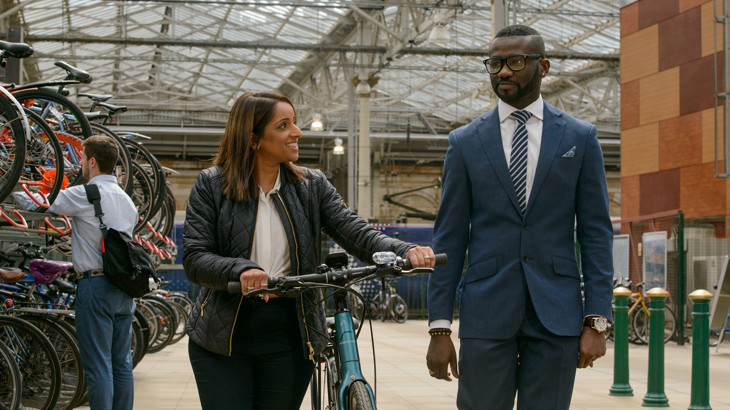
Cleaner air starts with how we move. Making it easier to walk, wheel and cycle is one of the most effective ways to reduce transport-related pollution at a local level. Credit: John Linton
Our liveable neighbourhood projects take this further; tackling traffic-heavy residential streets through co-designed solutions.
By engaging local community members, our engineers and designers work alongside residents to co-design projects that address the needs of local people.
From safer routes to greener spaces, these projects rebalance how streets are used; including areas to play, to socialise and making it easier and safer to walk, wheel and cycle.
These can be complex projects, sometimes with a risk of displacing air pollution to adjoining areas rather than eliminating it all together.
To understand this better we have recently conducted research funded by Transport Scotland which reviews the most important components for effective liveable neighbourhood designs.
Done well, however, they don’t just move pollution - they reduce it, creating places where people, not traffic, come first.

Active journeys: building healthy and greener habits for life
We’re market-leading experts in designing and delivering behaviour change and engagement solutions which create happier lives and healthier places for everyone.
Because when we change how we travel, we change everything. Our health. Our wellbeing. Our world.
What you can do
Be an advocate for more school streets or liveable neighbourhoods where you live or where you see it could make a difference.
Engage your local councillors or link with community groups to explore what can be done to make walking, wheeling and cycling safer and more accessible to address local air pollution hotspot.
Lean more about air pollution and the national Clean Air Day campaign on the Clean Air Hub created by environmental charity Global Action Plan.


